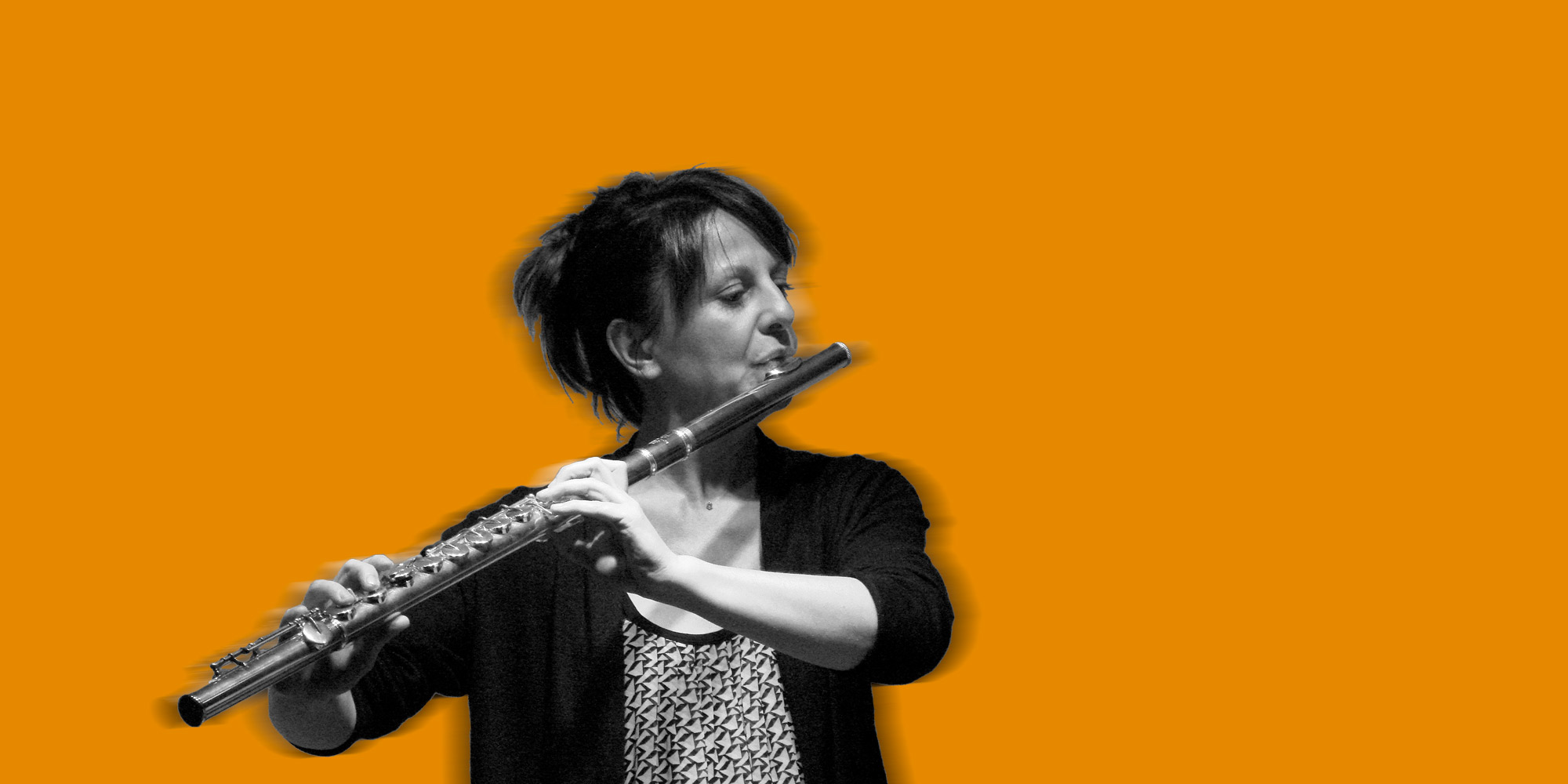

Neaji Ensemble – Emmanuelle Rouaud (shakuhachi) and Henri Algadafe (composer, electronics & electric guitar) – a collaboration to create new contemporary repertoire for shakuhachi.

Neaji: Japanese term ‘音味’ which can be translated as ‘flavour of sound’, evoking timbres and tonal colours.
In this new artistic project as Neaji Ensemble, being the result of a long musical collaboration, Emmanuelle Rouaud and Henri Algadafe explore the interactions of their respective instruments – the shakuhachi and the electric guitar – mixed with electronic sounds. The original repertoire created for this duo by Henri Algadafe develops a protean sound universe that mirrors a complex world where contrasts, oppositions, ruptures, poetry and dreaminess coexist.
While the compositions play on the cultural codes conveyed by the instruments (the electric guitar associated with rock and the shakuhachi with a certain type of Asian music), the musicians’ playing is nourished by a traditional heritage.
Embracing a 15-century long history, the shakuhachi is Japan’s emblematic bamboo flute, whose instrumental technique, rich in a wide range of timbres and playing modes, conceals a high expressive potential. The electric guitar, with a more recent history, is quick to transform itself through amplification, electronic processing and various modes of attack.
A computer system, whose role is carefully defined, is a full-fledged partner in the performance. It produces multiple sound sources from transformations of the instrumental performance, real-time synthesis, pre-recorded audio files, and random procedures. Listening to the instrumentalists and operating autonomously, the system is capable of triggering predetermined sound events.
This initial phase of working as a duo has resulted in five original works written between 2014 and 2025 :
As it rises, so it falls (2025)
For shakuhachi in B (2.3) and live electronics – 12’25”
The work ‘As it rises, so it falls’, whose title reveals the programme to come, follows a bell-shaped trajectory in which the relationship between instrument and electronics becomes increasingly flexible and independent. While constrained in terms of dynamics, harmonic content and density of events, the computer system generates sound patterns with a random profile. The instrumental writing exploits all the registers of the shakuhachi, beginning in the low register, the melodic line progresses towards the extreme high register to complete its journey where it began.
World premiere at the International Shakuhachi Festival in Texas, USA, 2025.
36º25’N 12º33’E (2023)
For shakuhachi in A (2.4), electric guitar and live electronics – 20’08″
The initial idea behind the piece can be summarised as follows: ‘Two bodies in phase gradually shift, move apart and disappear’. The composer sets the action at GPS coordinates 36º25’N 12º33’E, a point located in the Mediterranean Sea halfway between the Tunisian and Italian coasts. This environment, which readily stimulates the imagination, generates a work populated by concrete sounds with marine overtones, political speeches and instrumental sounds transformed by computer technology. The instrumental writing follows the initial idea: initially in phase, the instruments gradually drift apart and become independent.
Un Long Chemin Sinueux (2022)
For shakuhachi in A (2.4) and live electronics – 16’40”
A walker moves along a path and takes side roads that lead him to places he did not intend to go. The piece is written as an assembly of fragments of different lengths, aspects, densities, and speeds, illustrating the idea of wandering. The work was composed in 2022 for Emmanuelle Rouaud. World premiere at the European Shakuhachi Society concert, Ireland, 2023.
Contraction, Expansion, Résolution ou les rêveries cosmologiques d’un promeneur égaré / Contraction, Expansion, Resolution, or the cosmological musings of a lost wanderer (2020–2021)
For shakuhachi in A (2.4), electric guitar, and live electronics – 16’31.
Here, each musical idea is the consequence of the previous one. This is how the piece was constructed, a succession of nine dreamlike moments. Although the work contains heterogeneous elements, care is taken throughout to repeat elements (rhythms, timbres, computer processing) that have already been introduced, thus binding the whole together. World Premier at the European Shakuhachi Society Concert at Sibelius Museum, Turku, Finland 2024.
De vagues et d’élans / Of Waves and Motions (2014)
For shakuhachi in D (1.8) and electric guitar – 9’07”
A work without electronics, ‘De vagues et d’élans’ was originally composed for shakuhachi and classical guitar. The version presented here, played on electric guitar, respects the original ‘classical’ instrumental writing without introducing elements characteristic of the electric world (instrumental techniques or effects). The poetic image of a wave is at the origin of this composition. The dynamics of the phrases and melodic motifs in the work reflect this. The musical writing follows a contrapuntal logic in which the instrumental lines intertwine, complement and support each other.
World premiere at the Concert d’1 Soir, CRR Versailles Grand Parc, France, 2017.
Other composition/performances
I Thought About Eva (2018)
For shakuhachi in D (1.8) and koto – 10’
The work was composed in 2018 for Emmanuelle Rouaud.
World Premiere at the World Shakuhachi Festival in London, UK, 2018.
Concerts / Venues
International Shakuhachi Festival in Texas, USA, 2025 /Texas A&M University
Sibelius Museum, Turku, Finland 2024
Irish of Music & Song, Balbriggan/County Dublin, Ireland, 2023
Winter Concert – Traditional Japanese Music, France, 2019 / Montigny-le-Bretonneux
World Shakuhachi Festival in London, UK, 2018 / Goldsmiths University of London, Great Hall, Richard Hoggart Building
Concert d’1 Soir season, CRR Versailles Grand Parc, France, 2017 / Castle of Buc
Workshops / Teaching
Workshop/Lecture De vagues et d’élans for shakuhachi and guitar (Henri Algadafe, 2014):
European Shakuhachi Summer School July 2023 / Irish of Music & Song, Balbriggan, Ireland
World Shakuhachi Festival in Texas, USA, April 2025 /Texas A&M University
Biographical note – Henri Algadafe, composer
Henri Algadafe
Composer, electric guitarist and music lecturer, Henri Algadafe synthesises the many influences inherited
from his eclectic career in his compositions.
Raised on traditional Spanish sounds, then rock, before opening up to jazz, which led him to contemporary and electronic music, he now devotes himself to his compositions, juggling between instrumental and electronic writing. He holds degrees in harmony, orchestration and composition (CNR de Rueil-Malmaison) and electro-acoustic music (DEM under the supervision of Philippe Leroux).
He receives commissions from performers (such as Emmanuelle Rouaud) and institutions such as Art Zoyd studio, Musiques Nouvelles and various conservatories for the writing of educational pieces. His works have been performed in France and abroad (Germany, England, Argentina, Australia, China, Spain, Finland, and others).
For several years, his collaboration with Emmanuelle Rouaud has given him the opportunity to explore the technical and expressive possibilities of Asian instruments such as the shakuhachi and the koto through the creation of several works for them. A significant part of his work aims to bring together the worlds of acoustic and electronic sound by creating a unique acoustic space. Finally, he is continuing a project, begun 10 years ago, focusing on the electric guitar and the creation of a solo repertoire.
https://www.henrialgadafe.com/
New Horizons Concert, World Shakuhachi Festival London 2018
World premiere at the Concert d’1 Soir, CRR Versailles Grand Parc, France, 2017.